
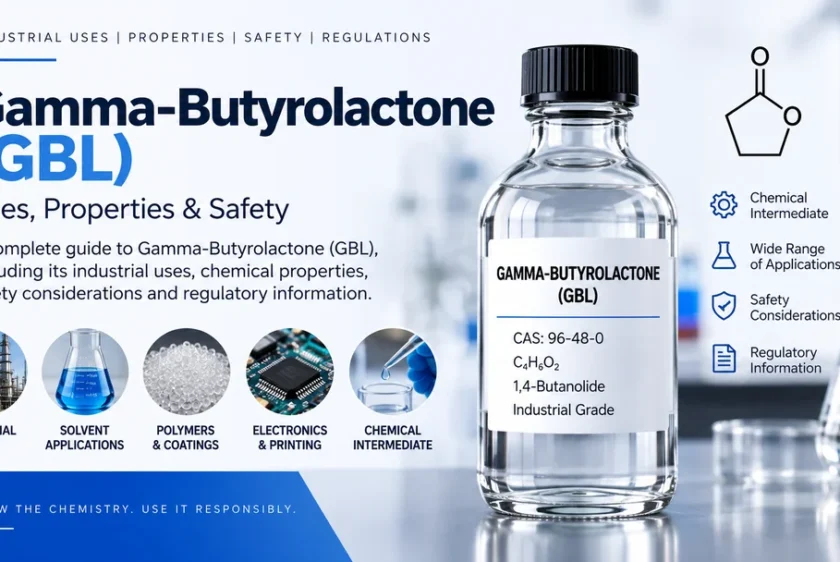
Gamma-Butyrolactone (GBL) is a colorless organic liquid used primarily as an industrial solvent and chemical intermediate. It is also known as γ-butyrolactone, 1,4-butanolide, butyrolactone, or GBL. Its CAS number is 96-48-0, its molecular formula is C₄H₆O₂, and its molecular weight is approximately 86.09 g/mol. GBL has applications in chemical manufacturing, polymers, coatings, electronics, printing inks, petroleum processing, pharmaceuticals, and other industrial processes.
GBL is an important industrial chemical, but it also requires careful handling. It has significant toxicological and regulatory considerations, and legal requirements can differ between countries. In particular, GBL is closely associated with gamma-hydroxybutyric acid (GHB), a substance with serious health and legal implications. For professional use, buyers should verify the applicable regulations and use the current Safety Data Sheet (SDS) for the specific product.
What Does GBL Stand For?
GBL stands for Gamma-Butyrolactone.
The chemical is also known by several names, including:
- Gamma-Butyrolactone
- γ-Butyrolactone
- GBL
- Butyrolactone
- 1,4-Butanolide
- 4-Butyrolactone
- Dihydro-2(3H)-furanone
- Oxolan-2-one
- 2(3H)-Furanone, dihydro-
ECHA identifies gamma-butyrolactone with CAS number 96-48-0 and EC number 202-509-5.
What Is Gamma-Butyrolactone Made Of?
Gamma-Butyrolactone is a cyclic ester known as a lactone.
Its molecular formula is:
C₄H₆O₂
Its molecular weight is:
86.09 g/mol
Its CAS number is:
96-48-0
PubChem identifies the systematic IUPAC name as oxolan-2-one.
The molecule contains four carbon atoms, six hydrogen atoms, and two oxygen atoms arranged in a five-membered cyclic structure.
What Does GBL Look Like?
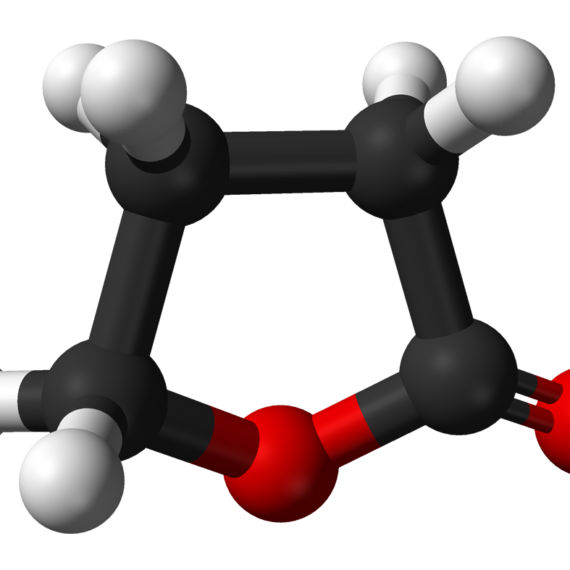
Gamma-Butyrolactone is generally described as a clear, colorless oily liquid. PubChem’s chemical information describes it as a clear, colorless oily liquid, while EPA documentation notes its high water solubility and moderate vapor pressure.
Basic identification information includes:
| Property | Information |
|---|---|
| Chemical name | Gamma-Butyrolactone |
| Common abbreviation | GBL |
| CAS number | 96-48-0 |
| EC number | 202-509-5 |
| IUPAC name | Oxolan-2-one |
| Molecular formula | C₄H₆O₂ |
| Molecular weight | 86.09 g/mol |
| Physical form | Liquid |
| Appearance | Clear/colorless oily liquid |
| Chemical family | Lactone |
Exact commercial specifications can vary by grade and supplier.
What Is GBL Used For?
GBL has several legitimate industrial uses.
According to U.S. EPA information, industrial applications include its use as a chemical intermediate, solvent for polymers, component in certain formulations, cosolvent in electronics-related applications, printing-ink solvent, and extracting solvent in petroleum-related applications.
Major industrial applications include:
- Chemical manufacturing
- Polymer processing
- Electronics
- Printing inks
- Coatings
- Petroleum processing
- Pharmaceuticals
- Agricultural chemical manufacturing
- Chemical research
- Specialty industrial formulations
1. GBL as an Industrial Solvent
One of the important properties of GBL is its usefulness as a solvent.
EPA documentation identifies GBL as a solvent for polymers and describes its use in several industrial formulations.
A solvent is a substance used to dissolve, carry, or process another material.
GBL can therefore be useful in industrial processes involving compatible:
- Polymers
- Resins
- Coatings
- Chemical intermediates
- Formulations
- Processing materials
The appropriate grade depends on the specific industrial process.
2. GBL in Chemical Manufacturing
GBL can be used as a chemical intermediate in the manufacture of other chemicals.
EPA information identifies GBL as an intermediate in the production of substances including N-methylpyrrolidone (NMP) and 2-pyrrolidone.
This makes GBL relevant to chemical manufacturers that use it as a feedstock or intermediate within controlled production processes.
3. GBL in Polymer Processing
GBL has applications involving polymers and polymer-related materials.
Its solvent properties can make it useful for selected polymer-processing applications where a suitable organic solvent is required.
The exact suitability depends on the polymer, formulation, temperature, concentration, and manufacturing process.
4. GBL in Electronics
GBL has been used in certain electronics-related applications.
EPA documentation identifies its use as a cosolvent for capacitor electrolytes and electronic photoresists.
This illustrates how specialty solvents such as GBL can play a role in precision manufacturing.
5. GBL in Printing Inks
GBL has also been used as a solvent in printing inks, including certain ink-jet printing applications.
Its solvent characteristics can make it useful for selected formulations where the chemical compatibility and evaporation profile are appropriate.
6. GBL in Petroleum Processing
EPA documentation identifies GBL as an extracting solvent used in the petroleum industry.
Industrial extraction processes can require specialized solvents selected according to the materials being separated and the process conditions.
7. GBL in Pharmaceutical Manufacturing
GBL has been associated with pharmaceutical and chemical manufacturing applications.
Its use in a particular pharmaceutical process depends on the manufacturing specification and applicable regulatory requirements.
Professional pharmaceutical manufacturers must use materials that meet the relevant quality, documentation, and regulatory standards.
8. GBL in Agricultural Chemical Manufacturing
EPA information identifies GBL as an intermediate used in the manufacture of certain agricultural chemicals, including herbicides and growth regulators.
This is another example of GBL being used as an industrial chemical intermediate rather than simply as a solvent.
Why Is GBL Useful as a Solvent?
GBL has several chemical properties that make it useful in industrial processes.
High Water Solubility
EPA’s hazard characterization describes GBL as having high water solubility.
Organic Solvent Properties
GBL can dissolve or process various organic materials and is used as a solvent in polymer and other industrial applications.
Chemical Stability in Appropriate Applications
Its chemical structure allows it to be incorporated into controlled industrial processes as a solvent or intermediate.
Versatile Industrial Applications
Its use spans chemical manufacturing, polymers, electronics, printing, petroleum processing, and other industries.
GBL and Chemical Intermediates
A chemical intermediate is a substance used to produce another chemical.
GBL is important in this context because EPA documentation identifies it as an intermediate in the manufacture of chemicals such as N-methylpyrrolidone and 2-pyrrolidone.
This means that some industrial users purchase GBL not as the final ingredient in a consumer product, but as part of a controlled chemical manufacturing process.
Is GBL the Same as GHB?
No. GBL and GHB are different chemical substances.
However, they are closely related chemically, and GBL can be converted in the body to GHB. PubChem identifies GBL as a precursor of gamma-hydroxybutyrate (GHB).
This relationship is one reason GBL has significant regulatory and safety considerations.
GBL should therefore not be treated as an ordinary household or general-purpose solvent.
Is GBL Dangerous?
GBL requires careful handling.
PubChem identifies gamma-butyrolactone as having toxicological concerns, while regulatory databases contain extensive information concerning its hazards and regulatory status.
Exposure risks depend on factors including:
- Concentration
- Quantity
- Route of exposure
- Exposure duration
- Workplace conditions
- Ventilation
- Individual susceptibility
Professional users should consult the current SDS for the exact product and follow appropriate workplace controls.
GBL Safety
When GBL is used in a professional environment, chemical safety procedures should be established before handling the substance.
Important considerations include:
- Appropriate ventilation
- Suitable chemical-resistant protective equipment
- Eye protection
- Controlled storage
- Proper labeling
- Spill-response procedures
- Appropriate waste management
- Worker training
- Access controls
- Current SDS documentation
The exact precautions should be determined from the current SDS, workplace risk assessment, and applicable regulations.
Is GBL Legal?
The legal status of GBL varies by jurisdiction and intended use.
This is an important consideration for anyone researching or purchasing the chemical.
GBL has legitimate industrial applications, but some countries regulate it because of its relationship to GHB and its potential for misuse.
For example, ECHA’s regulatory information shows that GBL is subject to multiple European regulatory processes and maintains a dedicated substance record for CAS 96-48-0.
Therefore, before purchasing, importing, exporting, storing, or using GBL, professional users should check the rules that apply in the specific country and intended application.
A chemical that can legally be supplied for an industrial application in one jurisdiction may be subject to additional controls in another.
GBL Regulatory Considerations
Regulatory requirements can involve:
- Chemical registration
- Import requirements
- Export controls
- Storage requirements
- Workplace rules
- Transportation requirements
- Record keeping
- Supplier obligations
- End-use restrictions
ECHA’s current substance information lists gamma-butyrolactone under several regulatory processes, while its dossier evaluation status was updated in September 2026.
Because regulations can change, current official government and regulatory sources should be checked before commercial transactions.
GBL CAS Number
The CAS number for Gamma-Butyrolactone is:
96-48-0
Its EC number is:
202-509-5
The molecular formula is:
C₄H₆O₂
The molecular weight is:
86.09 g/mol
Using the CAS number when discussing or specifying GBL can help avoid confusion between similarly named chemicals.
GBL in Industrial Research
GBL can be encountered in professional chemical research involving:
- Solvent systems
- Polymer chemistry
- Chemical intermediates
- Materials science
- Electronics materials
- Chemical manufacturing research
- Industrial formulation development
Researchers should select the appropriate chemical grade and follow their institution’s chemical-safety procedures.
What Industries Use GBL?
GBL has applications across several industrial sectors.
Chemical Manufacturing
Used as a solvent and chemical intermediate.
Polymer Industry
Used as a solvent for certain polymer systems.
Electronics
Used in selected electronics manufacturing processes, including applications involving photoresists and capacitor electrolytes.
Printing
Used as a solvent in certain printing-ink formulations.
Petroleum
Used as an extracting solvent in certain petroleum-related applications.
Agricultural Chemicals
Used as an intermediate in manufacturing certain agricultural chemicals.
Pharmaceutical and Chemical Research
Used in controlled chemical and pharmaceutical manufacturing processes.
GBL and Industrial Products
EPA chemical-use information shows GBL associated with a broad range of product categories, including adhesives and adhesive removers, paint and stain products, and printer inks.
This demonstrates that GBL can appear in industrial formulations even when the final product is not itself labeled simply as a “GBL product.”
How Is GBL Supplied?
GBL can be supplied as a chemical raw material for legitimate professional applications.
Commercial buyers should evaluate:
- Chemical identity
- CAS number
- Grade
- Purity
- Packaging
- SDS
- Certificate of Analysis
- Batch information
- Regulatory status
- Intended use
- Destination-country requirements
The appropriate specification depends on the application.
Buying GBL for Industrial Use
Businesses that require GBL for legitimate industrial processes should first determine whether its use and supply are permitted under the laws that apply to their operation.
Before purchasing, professional buyers should verify:
- Chemical identity
Confirm Gamma-Butyrolactone, CAS 96-48-0. - Required grade
Select a specification suitable for the intended industrial process. - Purity
Confirm the required purity from the supplier’s documentation. - Documentation
Request the current SDS and, where appropriate, COA and TDS. - Regulatory requirements
Confirm that the intended purchase, possession, import, export, and use are lawful in the relevant jurisdiction. - Shipping requirements
Confirm that the chemical can legally be transported to the destination.
Why Product Documentation Matters
Chemical documentation is particularly important for GBL.
A Safety Data Sheet (SDS) provides information about hazards, handling, storage, emergency response, and transportation.
A Certificate of Analysis (COA) can provide batch-specific information about the supplied material.
A Technical Data Sheet (TDS) can provide product specifications and technical characteristics.
Professional buyers should review these documents before accepting a chemical shipment.
Frequently Asked Questions
What is Gamma-Butyrolactone?
Gamma-Butyrolactone, commonly called GBL, is an organic chemical used primarily as an industrial solvent and chemical intermediate. It has the CAS number 96-48-0 and molecular formula C₄H₆O₂.
What does GBL stand for?
GBL stands for Gamma-Butyrolactone.
What is the CAS number of GBL?
The CAS number of Gamma-Butyrolactone is 96-48-0. Its EC number is 202-509-5.
What is GBL used for?
GBL is used as an industrial solvent and chemical intermediate. Applications include chemical manufacturing, polymers, electronics, printing inks, petroleum processing, agricultural chemicals, and selected pharmaceutical and industrial processes.
Is GBL a solvent?
Yes. GBL is used as a solvent for polymers and in several industrial formulations and processes.
What is the molecular formula of GBL?
The molecular formula of Gamma-Butyrolactone is C₄H₆O₂.
What is the molecular weight of GBL?
Gamma-Butyrolactone has a molecular weight of approximately 86.09 g/mol.
Is GBL the same as GHB?
No. GBL and GHB are different chemicals, although GBL is a precursor to GHB in the body.
Is GBL legal?
The legal status of GBL varies by country and by the intended use. It has legitimate industrial applications but is subject to regulatory controls in some jurisdictions. Buyers should check the current rules applicable to their location and use.
Is GBL dangerous?
GBL can pose significant health risks and should be handled as a professional chemical. Users should consult the current SDS and follow appropriate workplace controls.
Can GBL be used in manufacturing?
Yes. EPA documentation identifies GBL as a chemical intermediate and solvent used in multiple industrial manufacturing applications.
Is GBL used in electronics?
Yes. EPA documentation identifies GBL as a cosolvent used in capacitor electrolytes and electronic photoresists.
Is GBL used in printing inks?
Yes. GBL has been used as a solvent in printing inks, including certain ink-jet printing applications.
Is GBL used in petroleum processing?
Yes. EPA documentation identifies GBL as an extracting solvent in the petroleum industry.
What should I check before purchasing GBL?
Check the chemical identity, CAS number, grade, purity, SDS, COA where appropriate, packaging, intended use, and the regulatory requirements that apply to the transaction and destination.
Conclusion
Gamma-Butyrolactone (GBL) is an industrial chemical used primarily as a solvent and chemical intermediate. With the chemical formula C₄H₆O₂ and CAS number 96-48-0, GBL has applications in chemical manufacturing, polymer processing, electronics, printing inks, petroleum processing, agricultural chemical production, and other specialized industrial processes.
GBL should not be treated as an ordinary general-purpose chemical. Its relationship to GHB, health risks, and jurisdiction-specific regulatory controls make proper documentation and regulatory verification particularly important. Professional users should consult current official regulations and the product’s SDS before purchasing or using GBL.


1 Comment
[…] GBL […]