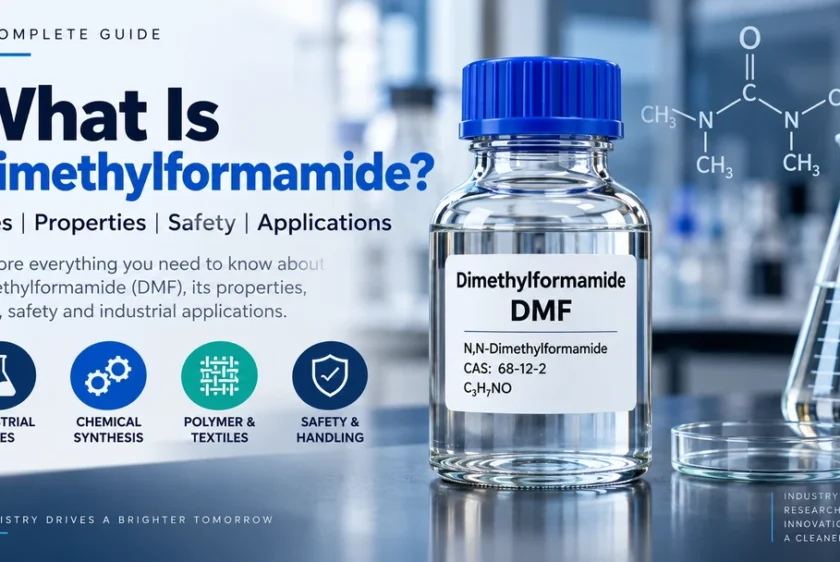
Dimethylformamide, commonly called DMF, is a clear, colorless organic liquid widely used as a powerful industrial and laboratory solvent. Its full chemical name is N,N-dimethylformamide, and its CAS number is 68-12-2. DMF is especially useful because it can dissolve many organic and inorganic substances that are difficult to dissolve in other common solvents. It is used in polymer processing, acrylic fiber production, coatings, pharmaceuticals, chemical manufacturing, textiles, and laboratory research.
DMF is an important industrial chemical, but it is also a hazardous substance that requires appropriate workplace controls. It can be absorbed through the skin and inhaled, and regulatory sources identify significant health hazards associated with exposure. For professional applications, users should always follow the current Safety Data Sheet (SDS), applicable workplace regulations, and supplier instructions.
What Does DMF Stand For?
DMF stands for N,N-dimethylformamide.
It is also commonly referred to as:
- Dimethylformamide
- N,N-Dimethylformamide
- Dimethyl formamide
- N-Formyldimethylamine
- DMF
- CAS 68-12-2
Its molecular formula is C₃H₇NO, and its molecular weight is approximately 73.09 g/mol.
The name describes its chemical structure. DMF is a formamide in which the two hydrogen atoms attached to nitrogen are replaced by methyl groups.
What Does Dimethylformamide Look Like?
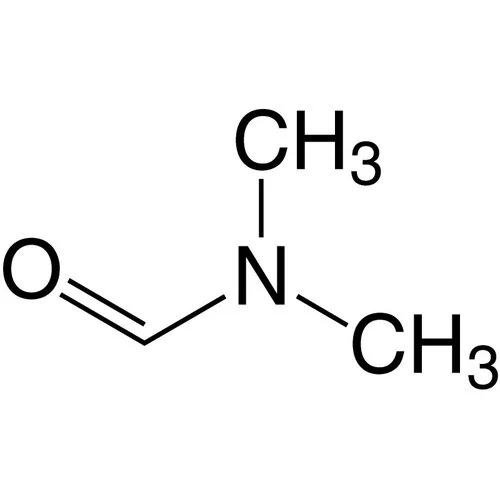
Pure DMF is normally a clear or colorless liquid. Some references describe it as water-white, while others describe commercial material as colorless to pale yellow.
It has a characteristic faint amine-like or fishy odor. DMF is slightly less dense than water, and its vapors are heavier than air.
Some important physical characteristics include:
| Property | Information |
|---|---|
| Chemical name | N,N-Dimethylformamide |
| Common name | DMF |
| CAS number | 68-12-2 |
| Molecular formula | C₃H₇NO |
| Molecular weight | 73.09 g/mol |
| Appearance | Clear/colorless liquid |
| Odor | Faint amine-like/fishy odor |
| Density | Approximately 0.95 g/cm³ |
| Chemical type | Organic solvent |
| Main role | Industrial and laboratory solvent |
Exact specifications can vary depending on the grade and supplier, so users should refer to the product’s current technical documentation for purchasing or process requirements.
What Is Dimethylformamide Used For?
Dimethylformamide is mainly used as a high-performance solvent in industrial manufacturing and chemical research.
Its ability to dissolve a wide range of materials makes it valuable in processes where ordinary solvents may not work well.
Common applications include:
1. Polymer Manufacturing
One of the major uses of DMF is in polymer processing.
DMF can dissolve certain polymers and is used in processes involving:
- Polyacrylonitrile
- Polyurethane
- Polyamide
- Vinyl resins
- Synthetic polymers
- Polymer coatings
It can help manufacturers create polymer solutions that can then be processed into fibers, films, coatings, or other products.
2. Acrylic Fiber Production
DMF has an important role in the production of acrylic fibers.
It can be used to dissolve polymer materials before they are processed into fibers. This makes it useful in textile manufacturing and other industries that produce synthetic fibers.
DMF is particularly associated with processing polyacrylonitrile solutions for fiber production.
3. Pharmaceutical Manufacturing
DMF can also be used as a solvent during pharmaceutical manufacturing and chemical processing.
It may be used as a:
- Reaction solvent
- Processing solvent
- Crystallization medium
- Chemical synthesis solvent
The exact application depends on the manufacturing process and the required chemical grade.
4. Coatings
DMF can be used in the manufacture and processing of coatings.
It has been used with polyurethane and other polymer systems where a strong solvent is needed to produce an appropriate solution.
This makes DMF relevant to industrial coating and surface-treatment processes.
5. Synthetic Leather
DMF has been used in the manufacture of synthetic leather and artificial leather materials.
It can act as a solvent for polymer systems used to create the coating or structure of synthetic leather products.
6. Chemical Research
In laboratories, DMF is a widely used solvent for chemical reactions.
Researchers may select DMF when they need a polar aprotic solvent that can dissolve a wide range of chemical substances.
It is commonly encountered in organic chemistry and synthetic chemistry laboratories.
7. Textile Processing
DMF can be involved in textile and fiber-related manufacturing.
Its solvent properties make it useful in processes involving synthetic fibers, polymer solutions, coatings, and textile materials.
8. Paint and Coating Applications
DMF has also been used as a solvent in certain paint stripping and coating-related industrial applications.
However, the suitability of DMF depends on the specific formulation and process. It should not be assumed that DMF is appropriate for every coating or paint system.
Why Is DMF Such an Effective Solvent?
One of the main reasons DMF is widely used is its ability to dissolve many different chemical substances.
DMF is classified as a polar aprotic solvent.
In simple terms, this means that its chemical properties allow it to interact strongly with many polar substances and participate in a wide range of chemical processes without behaving like a typical proton-donating solvent.
This combination makes DMF useful for:
- Chemical reactions
- Polymer processing
- Pharmaceutical synthesis
- Laboratory research
- Coating production
- Fiber manufacturing
- Chemical extraction and processing
Its relatively high boiling point can also make it useful when a solvent needs to remain present during a process rather than evaporating immediately.
Is Dimethylformamide the Same as DMF?
Yes.
Dimethylformamide and DMF are two names for the same chemical.
The full name is:
N,N-Dimethylformamide
The abbreviation is:
DMF
The chemical has the CAS number:
68-12-2
When purchasing or specifying DMF, the CAS number can help confirm that the correct chemical is being discussed.
Is Dimethylformamide Safe?
DMF needs to be handled carefully because it is a hazardous chemical.
This is an important part of understanding what Dimethylformamide is.
According to chemical safety information compiled by PubChem and regulatory sources, DMF can be harmful through inhalation and skin contact. It can also cause serious eye irritation. European classification information identifies reproductive toxicity as a significant hazard.
Therefore, DMF should be treated as a professional industrial and laboratory chemical, not as an ordinary household solvent.
Workplaces using DMF should have appropriate:
- Chemical handling procedures
- Ventilation
- Personal protective equipment
- Storage procedures
- Spill-response procedures
- Waste-management procedures
- Worker training
- SDS documentation
The current supplier SDS should always be consulted before using a particular grade or formulation.
Can DMF Be Absorbed Through the Skin?
Yes.
One important characteristic of DMF is that it can be absorbed through the skin.
This is one reason that simply avoiding the smell of DMF is not an adequate safety strategy.
Chemical exposure can occur through:
- Skin contact
- Inhalation
- Eye contact
- Accidental ingestion
Appropriate workplace controls are therefore important when handling the chemical.
Is DMF Flammable?
DMF is a combustible/flammable liquid and should be kept away from ignition sources.
Its vapors can form hazardous mixtures with air under appropriate conditions. Transportation regulations also classify N,N-dimethylformamide as a Class 3 flammable liquid under U.S. Department of Transportation rules, with UN number UN2265.
For storage and transportation, users should follow the applicable SDS and local dangerous-goods requirements.
What Industries Use Dimethylformamide?
DMF has applications across several industries.
Chemical Manufacturing
DMF can be used as a solvent and reaction medium in chemical production.
Pharmaceutical Industry
It can be used in pharmaceutical processing, synthesis, and crystallization applications.
Textile Industry
DMF is associated with acrylic fiber and synthetic textile manufacturing.
Polymer Industry
It is used to process polymers and prepare polymer solutions.
Coatings Industry
DMF can be used in certain polyurethane and other coating systems.
Laboratory Research
Researchers use DMF as a solvent for many chemical reactions and laboratory processes.
Synthetic Leather Manufacturing
DMF has been used in processes involving polyurethane and synthetic leather materials.
These applications demonstrate why DMF remains an important industrial solvent despite its health and safety considerations.
Dimethylformamide in Chemical Research
DMF is particularly familiar to chemistry researchers.
A laboratory may select DMF when a reaction requires a solvent with strong dissolving ability and suitable polarity.
It can be useful for reactions involving:
- Organic compounds
- Polar compounds
- Polymer materials
- Chemical intermediates
- Pharmaceutical intermediates
- Synthetic chemistry
However, the choice of solvent should always be based on the specific reaction, compatibility requirements, laboratory procedures, and safety assessment.
What Is the Difference Between DMF and Other Solvents?
DMF has a different chemical profile from common solvents such as acetone, ethanol, methanol, and water.
One major reason chemists use DMF is its strong solvating ability for many substances that are not easily dissolved in less polar solvents.
For example:
Water is highly polar and is excellent for many ionic and highly polar substances.
Acetone is a polar organic solvent that evaporates relatively quickly.
Ethanol is a polar protic solvent that is widely used in laboratories and industry.
DMF is a polar aprotic solvent that is particularly useful for many organic reactions and polymer-processing applications.
The best solvent depends on the chemical process, desired reaction conditions, material compatibility, safety requirements, and downstream processing.
Dimethylformamide CAS Number
The CAS number for N,N-dimethylformamide is:
68-12-2
CAS numbers are useful because chemical names can sometimes vary between countries, suppliers, industries, and technical documents.
When purchasing or specifying DMF, checking the CAS number alongside the chemical name can help reduce the possibility of ordering the wrong substance.
What Grade of DMF Should You Buy?
The correct grade depends on how the chemical will be used.
Common considerations include:
Industrial Grade
Industrial-grade DMF may be appropriate for certain manufacturing processes where very high laboratory purity is not required.
Laboratory Grade
Laboratory applications may require tighter specifications and documented purity.
High-Purity Grade
Some applications require particularly controlled impurity levels.
Process-Specific Grade
Certain manufacturing processes may have their own specification requirements.
Before purchasing DMF, buyers should check:
- Purity
- Water content
- Impurity profile
- Appearance
- Packaging
- SDS
- Certificate of Analysis
- Technical Data Sheet
- Required grade
- Intended application
The appropriate specification should be determined by the actual process rather than simply selecting the highest-priced grade.
Buying Dimethylformamide
If you are looking to buy dimethylformamide, start by identifying the required grade and quantity.
Professional buyers should compare suppliers based on documentation, product specifications, packaging, delivery requirements, and regulatory compliance.
For commercial or laboratory purchasing, useful documentation may include:
- Certificate of Analysis (COA)
- Safety Data Sheet (SDS)
- Technical Data Sheet (TDS)
- Product specification
- Batch information
- Packaging information
A reputable chemical supplier should be able to provide documentation appropriate for the product and intended market.
Dimethylformamide for Sale
DMF is commercially supplied for industrial and laboratory applications.
Depending on the supplier and market, it may be available in different package sizes and grades.
When searching for dimethylformamide for sale, avoid choosing a product based only on price.
Instead, check whether the product actually matches your required:
- Chemical identity
- CAS number
- Purity
- Grade
- Packaging
- Documentation
- Delivery requirements
This is particularly important because DMF is a hazardous chemical subject to workplace, transportation, and environmental requirements.
Why Product Documentation Matters
Chemical documentation is important because the same chemical name can be offered in different grades and specifications.
A COA can provide batch-specific information.
An SDS explains hazards, handling, storage, transportation, and emergency information.
A TDS generally provides product specifications and technical characteristics.
Together, these documents help professional users determine whether a particular DMF product is suitable for their application.
Frequently Asked Questions
What is dimethylformamide?
Dimethylformamide, or DMF, is a clear organic liquid widely used as an industrial and laboratory solvent. Its full name is N,N-dimethylformamide, and its CAS number is 68-12-2.
What is DMF used for?
DMF is used in polymer processing, acrylic fiber production, coatings, pharmaceutical manufacturing, synthetic leather, textiles, chemical synthesis, and laboratory research.
What does DMF stand for?
DMF stands for N,N-dimethylformamide.
What is the CAS number of DMF?
The CAS number of N,N-dimethylformamide is 68-12-2.
Is DMF a solvent?
Yes. DMF is a widely used polar aprotic organic solvent and is particularly useful for dissolving many substances and supporting chemical reactions.
Is dimethylformamide dangerous?
DMF presents significant health and fire hazards. It can be harmful through skin contact or inhalation, can cause serious eye irritation, and is classified for reproductive toxicity under EU chemical classification information.
Can DMF pass through the skin?
Yes. DMF can be absorbed through the skin, which is why appropriate protective measures are important when handling it.
Is DMF flammable?
DMF is classified as a flammable/combustible liquid and must be kept away from ignition sources. U.S. transportation information identifies it as UN2265, Class 3.
Is DMF used in pharmaceutical manufacturing?
Yes. DMF can be used as a solvent, reaction medium, and crystallization medium in pharmaceutical and chemical manufacturing processes.
Is DMF used to make acrylic fibers?
Yes. DMF is used in processing polymer solutions for acrylic fiber production, particularly polyacrylonitrile-based materials.
Is DMF the same as N,N-dimethylformamide?
Yes. N,N-dimethylformamide is the full chemical name, while DMF is the common abbreviation.
Where can I buy dimethylformamide?
DMF is supplied commercially for professional industrial and laboratory applications. Buyers should confirm the chemical identity, grade, purity, documentation, packaging, and applicable regulatory requirements before purchasing.
Conclusion
Dimethylformamide (DMF) is a powerful industrial and laboratory solvent with applications across chemical manufacturing, polymer processing, acrylic fiber production, pharmaceuticals, coatings, textiles, synthetic leather, and scientific research. Its chemical name is N,N-dimethylformamide, its formula is C₃H₇NO, and its CAS number is 68-12-2.
DMF is useful because of its strong solvent properties, but it is also a hazardous chemical that requires professional handling. Anyone purchasing or using DMF should select the appropriate grade and review the current SDS and technical documentation before use.


1 Comment
[…] Acetone is useful because it can dissolve many substances and mixes readily with water. It also evaporates quickly, which makes it valuable for cleaning and processing applications where a solvent needs to disappear after use. However, acetone is highly flammable, so professional users must handle, store, and transport it according to the applicable safety requirements. […]