
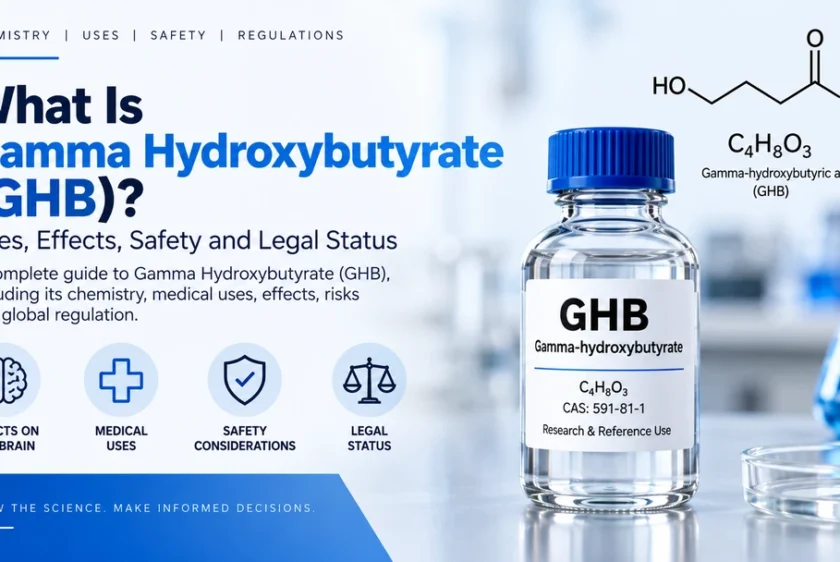
Gamma-hydroxybutyrate (GHB) is a naturally occurring neuroactive compound that affects the central nervous system. It is also known as gamma-hydroxybutyric acid, 4-hydroxybutyric acid, or 4-hydroxybutanoic acid. GHB has the molecular formula C₄H₈O₃, a molecular weight of 104.10 g/mol, and CAS number 591-81-1. It has important applications and research relevance in neuroscience, medicine, pharmacology, and toxicology, but it is also a controlled substance in many jurisdictions.
What Does GHB Stand For?
GHB stands for gamma-hydroxybutyrate.
The compound is commonly referred to as gamma-hydroxybutyric acid when discussing its acid form. Other chemical names include:
- Gamma-hydroxybutyric acid
- 4-Hydroxybutyric acid
- 4-Hydroxybutanoic acid
- Oxybate
- GHB
PubChem identifies gamma-hydroxybutyric acid with CAS 591-81-1, molecular formula C₄H₈O₃, and molecular weight 104.10 g/mol.
GHB Chemical Information
| Property | Information |
|---|---|
| Chemical name | Gamma-hydroxybutyric acid |
| Common name | GHB |
| CAS number | 591-81-1 |
| Molecular formula | C₄H₈O₃ |
| Molecular weight | 104.10 g/mol |
| IUPAC name | 4-Hydroxybutanoic acid |
| Chemical class | Hydroxy monocarboxylic acid |
| Related pharmaceutical | Sodium oxybate |
These identifiers are useful when reviewing scientific literature, analytical records, safety documentation, and regulatory information.
What Is the Chemical Structure of GHB?
GHB is a four-carbon hydroxy acid. Its molecular structure contains:
- Four carbon atoms
- Eight hydrogen atoms
- Three oxygen atoms
- A carboxylic acid group
- A hydroxyl group
The chemical structure is important because GHB’s biological activity is closely connected to the way its molecule interacts with receptors and metabolic pathways.
Is GHB Naturally Occurring?
Yes. GHB occurs naturally in the human body.
It is associated with metabolic pathways involving GABA, or gamma-aminobutyric acid. FDA documentation describes GHB as an endogenous compound and metabolite related to GABA.
However, naturally occurring does not mean that concentrated or externally administered GHB is automatically safe. GHB has significant effects on the central nervous system and can cause serious toxicity.
How Does GHB Affect the Body?
GHB is a central nervous system depressant.
It affects neurological signaling and can change levels of alertness and consciousness. Depending on exposure, effects can range from sedation and impaired coordination to severe central nervous system depression.
Serious exposure can involve:
- Reduced consciousness
- Respiratory depression
- Coma
- Seizures
- Other serious neurological effects
The FDA specifically warns that GHB and sodium oxybate can cause central nervous system depression and clinically significant respiratory depression.
What Is GHB Used For?
GHB has scientific and medical significance, but its uses must be distinguished from its regulated status.
The most important approved medical context is sodium oxybate, a pharmaceutical form related to GHB. Sodium oxybate is used in the treatment of certain symptoms associated with narcolepsy, including cataplexy and excessive daytime sleepiness.
GHB has also been studied in:
- Neuroscience
- Pharmacology
- Sleep research
- Toxicology
- Receptor biology
- Neurological research
- Forensic science
GHB and Sodium Oxybate
GHB and sodium oxybate are closely related, but they are not identical chemical forms.
GHB refers to gamma-hydroxybutyrate/gamma-hydroxybutyric acid.
Sodium oxybate is the sodium salt of GHB and is used as a regulated pharmaceutical.
The distinction is important because pharmaceutical products are manufactured, formulated, prescribed, labeled, and distributed under specific medical and regulatory requirements.
FDA documentation describes sodium oxybate as the sodium salt of GHB and identifies its approved use in narcolepsy.
Sodium Oxybate and Narcolepsy
Narcolepsy is a neurological sleep disorder associated with excessive daytime sleepiness and, in some patients, cataplexy.
Sodium oxybate has approved medical uses for these symptoms. FDA records list sodium oxybate products for the treatment of cataplexy and excessive daytime sleepiness associated with narcolepsy.
Because sodium oxybate is a central nervous system depressant and has misuse and abuse risks, its pharmaceutical use is subject to strict controls.
GHB in Scientific Research
GHB has been studied in several areas of scientific research.
Neuroscience
Researchers study GHB because of its effects on the central nervous system and its relationship with GABA-related signaling.
Sleep Research
GHB-related pharmacology has been studied extensively in connection with sleep and narcolepsy.
Pharmacology
Researchers examine how GHB interacts with receptors, how it is metabolized, and how it affects neurological processes.
Toxicology
GHB is also important in toxicology because significant exposure can produce severe central nervous system depression.
Forensic Science
Analytical laboratories may encounter GHB in forensic investigations. Interpretation can be complicated because GHB can also occur naturally in biological systems.
GHB Safety
GHB should not be treated as an ordinary laboratory solvent or general-purpose chemical.
High or uncontrolled exposure can produce serious effects on the central nervous system. The FDA warns about respiratory depression, decreased consciousness, coma, and other serious adverse effects associated with GHB and sodium oxybate.
Professional organizations working with regulated GHB-related materials should follow applicable safety documentation, institutional procedures, and legal requirements.
GHB and Other Central Nervous System Depressants
Combining GHB with other central nervous system depressants can substantially increase the risk of dangerous effects.
This is particularly important because substances that independently reduce nervous-system activity can have additive effects when combined.
The FDA specifically identifies increased risks associated with GHB exposure and other central nervous system depressants.
Why Is GHB Controlled?
GHB has powerful effects on the central nervous system and has a documented history of misuse and serious poisoning.
As a result, many countries regulate GHB and related pharmaceutical compounds.
In the United States, PubChem identifies gamma-hydroxybutyric acid as a DEA Schedule I controlled substance. Approved pharmaceutical formulations are treated differently under U.S. controlled-substance law.
The exact legal classification varies between countries and can also depend on the formulation and intended activity.
GHB Legal Status
There is no single worldwide legal classification for every GHB-related substance.
Regulatory requirements can involve:
- Possession
- Research
- Manufacture
- Importation
- Exportation
- Storage
- Transportation
- Pharmaceutical use
- Laboratory use
- Record keeping
Organizations should verify the current requirements that apply in their own jurisdiction before conducting regulated activities involving GHB.
GHB vs GBL
GHB is sometimes confused with gamma-butyrolactone (GBL) because the names are similar and the compounds are chemically related.
They are nevertheless different substances.
| Property | GHB | GBL |
|---|---|---|
| Full name | Gamma-hydroxybutyric acid | Gamma-butyrolactone |
| Abbreviation | GHB | GBL |
| Formula | C₄H₈O₃ | C₄H₆O₂ |
| CAS number | 591-81-1 | 96-48-0 |
| Chemical type | Hydroxy acid | Lactone |
| Major scientific context | Neuroscience, medicine, toxicology | Industrial chemistry and chemical processing |
For more information about GBL, see our detailed article:
What Is Gamma-Butyrolactone (GBL)?
Understanding the difference between these compounds is important for chemical identification, research documentation, safety information, and regulatory compliance.
GHB vs Sodium Oxybate
| Feature | GHB | Sodium Oxybate |
|---|---|---|
| Chemical relationship | Gamma-hydroxybutyric acid | Sodium salt of GHB |
| Formula | C₄H₈O₃ | C₄H₇NaO₃ |
| Molecular weight | 104.10 g/mol | Approximately 126.09 g/mol |
| Medical context | Controlled compound | Regulated pharmaceutical |
| Narcolepsy context | Source compound | Approved medical treatment |
| Regulatory controls | Significant | Significant |
The difference between the chemical compound and pharmaceutical formulation is important when discussing medical products, laboratory records, and regulatory classifications.
GHB and GABA
GHB and GABA are different chemicals, although they are biologically related.
GABA stands for gamma-aminobutyric acid and is an important inhibitory neurotransmitter.
GHB is gamma-hydroxybutyrate and has its own biological activity.
GHB is associated with GABA-related pathways and is also described as an endogenous metabolite related to GABA.
GHB in Toxicology
GHB is an important compound in toxicological research.
Laboratories may analyze GHB when investigating suspected exposure, poisoning, or other forensic questions.
Interpretation can be challenging because the compound occurs naturally in biological systems. This means that analytical results need to be evaluated using appropriate scientific methods and context.
Professional toxicology laboratories should use validated analytical procedures and suitable quality controls.
GHB in Forensic Research
Forensic scientists have studied GHB because of its presence in toxicology investigations.
The scientific challenge is not simply detecting a compound. Researchers may also need to understand:
- Biological background levels
- Sample handling
- Analytical methods
- Stability
- Timing
- Interpretation of results
These considerations make GHB an important subject in forensic analytical science.
GHB Chemical Documentation
Organizations conducting legitimate research or regulated laboratory work should maintain appropriate documentation.
Depending on the activity and jurisdiction, relevant documentation may include:
- Safety Data Sheet (SDS)
- Certificate of Analysis (COA)
- Chemical identity information
- Batch documentation
- Analytical specifications
- Regulatory classification
- Institutional authorization
- Controlled-substance records
The documentation should correspond to the exact material and formulation under investigation.
GHB Laboratory Research
Research involving GHB should be conducted only within the appropriate legal and institutional framework.
Professional laboratories may need to establish:
- Authorized personnel
- Controlled access
- Appropriate documentation
- Regulatory approvals
- Secure storage
- Laboratory safety procedures
- Waste-management procedures
- Record-keeping systems
The exact requirements depend on the country and the nature of the research.
Why Accurate GHB Identification Matters
Chemical names can sometimes be confusing, particularly when closely related substances are discussed together.
When identifying GHB, researchers should confirm:
- Chemical name
- CAS number
- Molecular formula
- Chemical structure
- Form or salt
- Analytical specification
- SDS
- COA
- Regulatory classification
This helps distinguish GHB from sodium oxybate, GBL, and other related compounds.
GHB Regulatory Information for Businesses
Businesses and research organizations should not assume that a chemical can be legally purchased, possessed, imported, stored, or used simply because it appears in a scientific database.
GHB has significant regulatory controls in many jurisdictions.
Before undertaking regulated activities, organizations should establish:
- The exact chemical identity.
- The applicable legal classification.
- Whether the intended activity requires authorization.
- Whether institutional approval is required.
- What storage and record-keeping rules apply.
- What transportation or import requirements apply.
For U.S. activities, federal controlled-substance requirements are particularly important. PubChem currently identifies gamma-hydroxybutyric acid as a DEA Schedule I substance, while FDA-approved sodium oxybate products have a different controlled-substance status.
Frequently Asked Questions
What is gamma hydroxybutyrate?
Gamma hydroxybutyrate, commonly called GHB, is a naturally occurring neuroactive compound that affects the central nervous system. Its molecular formula is C₄H₈O₃.
What does GHB stand for?
GHB stands for gamma-hydroxybutyrate. The acid form is commonly called gamma-hydroxybutyric acid.
What is the chemical formula of GHB?
The chemical formula of gamma-hydroxybutyric acid is C₄H₈O₃.
What is the CAS number of GHB?
The commonly listed CAS number for gamma-hydroxybutyric acid is 591-81-1.
What is the molecular weight of GHB?
GHB has a molecular weight of approximately 104.10 g/mol.
What is GHB used for?
GHB has scientific and medical significance. Its pharmaceutical form, sodium oxybate, is used under prescription for approved indications involving narcolepsy, including cataplexy and excessive daytime sleepiness.
What is sodium oxybate?
Sodium oxybate is the sodium salt of GHB and is a regulated pharmaceutical used for specific symptoms associated with narcolepsy.
Is GHB the same as sodium oxybate?
They are closely related but are different chemical forms. Sodium oxybate is the sodium salt of GHB and is used as a regulated pharmaceutical.
Is GHB the same as GBL?
No. GHB and GBL are different chemicals. GHB is gamma-hydroxybutyric acid, while GBL is gamma-butyrolactone.
Is GHB controlled?
Yes. GHB is controlled in many jurisdictions. In the United States, gamma-hydroxybutyric acid is identified as a Schedule I controlled substance, while approved pharmaceutical sodium oxybate is separately regulated.
Is GHB dangerous?
GHB can cause serious central nervous system depression. Severe exposure can result in respiratory depression, reduced consciousness, coma, and other serious outcomes.
Can GHB be studied in scientific research?
GHB has been studied in neuroscience, pharmacology, sleep research, toxicology, and forensic science. Research involving controlled GHB must comply with applicable legal and institutional requirements.
Why is GHB important in toxicology?
GHB can be relevant to forensic and clinical toxicology because it affects the central nervous system and can be detected in biological samples. Interpretation requires appropriate analytical methods and scientific context.
What is the difference between GHB and GBL?
GHB is gamma-hydroxybutyric acid with formula C₄H₈O₃, while GBL is gamma-butyrolactone with formula C₄H₆O₂. They are chemically related but are not the same substance.
Conclusion
Gamma-hydroxybutyrate (GHB) is a biologically active compound with important relevance to neuroscience, pharmacology, medicine, toxicology, and forensic science. It has the molecular formula C₄H₈O₃, molecular weight 104.10 g/mol, and CAS number 591-81-1.
GHB is also a highly regulated substance in many jurisdictions. Its pharmaceutical relationship with sodium oxybate is particularly important because approved sodium oxybate medicines are used for specific symptoms of narcolepsy under strict medical controls.
GHB should also be distinguished clearly from GBL, which is a separate chemical with different properties, formula, CAS number, and industrial context.
For organizations working with GHB-related research or regulated materials, accurate chemical identification, appropriate documentation, institutional controls, and compliance with applicable laws are essential.


1 Comment
[…] Gamma-Butyrolactone (GBL) is a colorless organic liquid used primarily as an industrial solvent and chemical intermediate. It is also known as γ-butyrolactone, 1,4-butanolide, butyrolactone, or GBL. Its CAS number is 96-48-0, its molecular formula is C₄H₆O₂, and its molecular weight is approximately 86.09 g/mol. GBL has applications in chemical manufacturing, polymers, coatings, electronics, printing inks, petroleum processing, pharmaceuticals, and other industrial processes. […]