
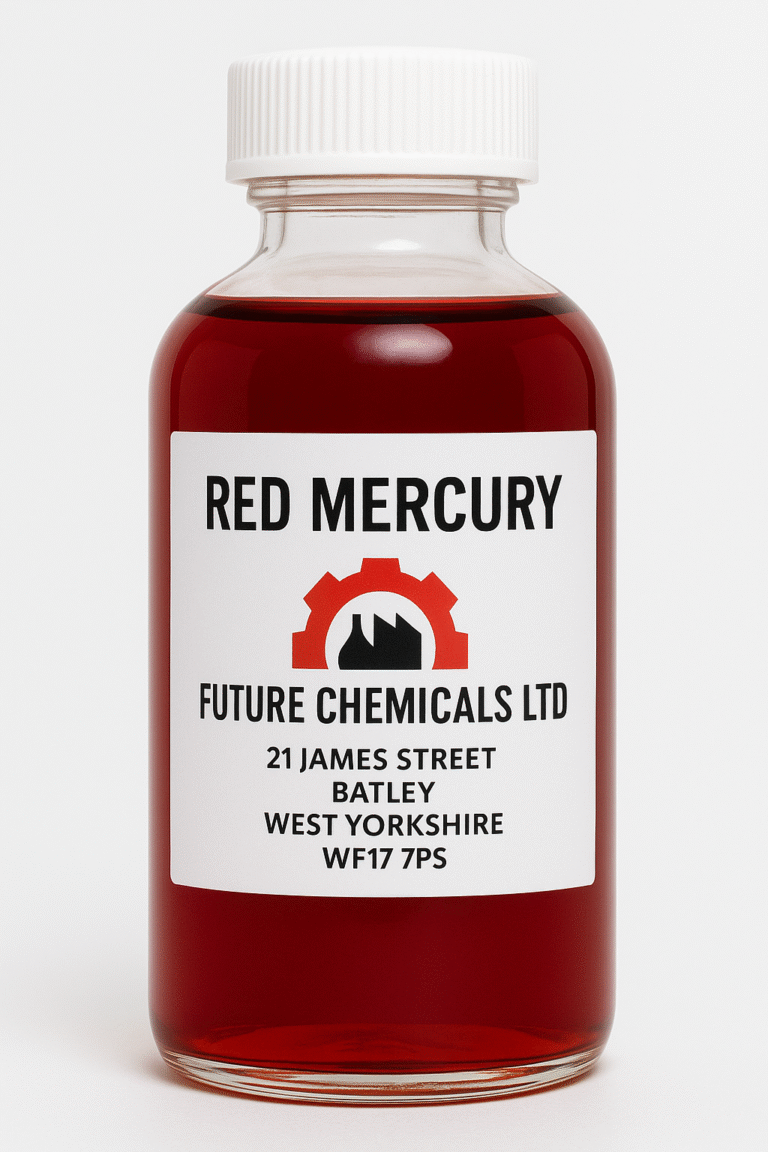
What Is Red Mercury Liquid?
“Red mercury liquid” is a name that has been used for decades in stories about secret nuclear materials, military technology, and alleged high-value chemical substances.
The difficulty is that red mercury does not have one universally accepted chemical formula, CAS number, molecular structure, or verified composition.
Different claims have described it as different substances, including alleged mercury-antimony compounds and other materials. Scientific investigations have not established these claims as evidence of a unique substance with the extraordinary properties sometimes attributed to red mercury.
This means that the name red mercury by itself is not sufficient to identify a chemical.
Is Red Mercury a Real Chemical?
There are genuine red-colored mercury compounds, but this does not establish the existence of the mysterious substance described in red-mercury stories.
This distinction is important.
A real chemical product normally has an identifiable:
- Chemical name
- Chemical formula
- CAS number
- Molecular weight
- Physical properties
- Hazard classification
- Manufacturer
- SDS
- COA
- Batch information
“Red mercury” does not provide a unique chemical identity by itself.
Scientific Investigation of Alleged Red Mercury
One of the most important published investigations involved an object seized by Zagreb police in 2003 after it was suspected of containing red mercury.
Researchers examined the object using 14.1 MeV neutron activation analysis and energy-dispersive X-ray fluorescence (EDXRF).
The analysis detected mercury, iron, chromium, and nickel. The researchers determined that iron, chromium, and nickel were associated with the capsule, while the material inside was mercury. Antimony, which had been proposed as a possible component in some red-mercury claims, was not detected.
The paper also noted that other alleged red-mercury samples investigated by laboratories had been identified as known mercury-containing materials, including elemental mercury, mercury oxide, or mercury iodide.
This is why independent analytical testing is important when a material is presented as red mercury.
What Is Red Mercury Liquid Used For?
There are no scientifically verified special applications for the alleged red-mercury substance.
Red mercury has been claimed to have uses involving:
- Nuclear weapons
- Fusion technology
- Military technology
- Specialized explosives
- Nuclear triggering systems
- Advanced weapons
- Secret energy technologies
However, these claims have not been established through reliable public scientific evidence.
The UK Parliament recorded in 1994 that the British Government had no evidence that red mercury had potential uses in nuclear weapons. A later parliamentary answer stated that there was no new evidence for the existence or usefulness of red mercury.
The International Atomic Energy Agency has also discussed “red mercury” within the context of false representations involving nuclear and radioactive materials. Its nuclear-security guidance describes cases involving purported nuclear materials that can be hoaxes or scams and specifically includes reports concerning red mercury.
Why Is Red Mercury Associated With Nuclear Technology?
The red-mercury story became particularly well known because it was repeatedly connected with alleged secret nuclear technology.
Different accounts have suggested that red mercury could supposedly:
- Initiate nuclear reactions
- Assist in fusion weapons
- Replace conventional nuclear materials
- Produce extremely powerful explosions
- Enable miniature nuclear devices
These descriptions vary considerably.
Scientific evidence has not established a unique red-mercury substance capable of performing these functions.
The UK Government stated in parliamentary records that it had no evidence of red mercury having nuclear-weapons applications.
Red Mercury and Alleged Nuclear Weapons
The nuclear-weapons association is one of the most important parts of the red-mercury story.
However, a claim about a material’s supposed military use does not establish its chemical identity.
The published scientific investigation of an alleged red-mercury sample found mercury in the investigated material rather than evidence of a previously unknown nuclear substance.
The IAEA’s nuclear-security material similarly places reports of red mercury among cases involving false representations of nuclear or radioactive materials.
Are There Real Red Mercury Compounds?
Yes.
Several genuine mercury compounds can have red or reddish appearances. These should be identified by their actual chemical names rather than simply being called red mercury.
Examples include:
Mercury(II) Sulfide
Mercury(II) sulfide is a genuine mercury compound and is associated with the red mineral cinnabar.
It has a defined chemical identity and should not be confused with the alleged secret substance known as red mercury.
Mercury(II) Oxide
Mercury(II) oxide is another genuine mercury compound that occurs in different colored forms.
Mercury(II) Iodide
Mercury(II) iodide is also a genuine mercury compound and can have a red appearance.
The existence of these compounds does not confirm the existence of a unique chemical called red mercury.
Red Mercury Liquid vs Real Mercury Compounds
| Material | Scientific Status | Identity |
|---|---|---|
| “Red mercury” | No unique established identity | General name used in historical claims |
| Elemental mercury | Established chemical element | Hg |
| Mercury(II) sulfide | Established compound | HgS |
| Mercury(II) oxide | Established compound | HgO |
| Mercury(II) iodide | Established compound | HgI₂ |
A legitimate chemical supplier should identify the actual compound rather than relying solely on the term “red mercury.”
Red Mercury Liquid Physical Properties
Because “red mercury” does not identify one established chemical substance, it is not scientifically appropriate to assign a universal:
- Density
- Melting point
- Boiling point
- Formula
- Molecular weight
- Vapor pressure
- CAS number
- Purity specification
to the term itself.
Different alleged samples may represent entirely different substances.
Therefore, physical specifications should only be published after the actual material has been chemically identified.
How Can Red Mercury Be Verified?
If a material is being marketed as red mercury, professional verification should focus on the actual chemical composition.
Useful documentation can include:
Chemical Identification
The material should have a specific chemical name and, where applicable, a recognized CAS number.
Certificate of Analysis
A COA can provide batch-specific analytical information from the supplier or testing laboratory.
Safety Data Sheet
An SDS should identify the substance and provide relevant hazard, handling, storage, and transportation information.
Independent Laboratory Analysis
For unusual or high-value chemical claims, independent laboratory testing can help determine what material is actually present.
Depending on the substance, professional laboratories may use appropriate analytical techniques such as spectroscopy, elemental analysis, X-ray fluorescence, mass spectrometry, or other validated methods.
The exact analytical method should be selected by a qualified laboratory based on the material being tested.
Why Chemical Verification Matters
A chemical’s appearance is not enough to establish its identity.
Two substances can have similar colors while having completely different:
- Chemical structures
- Hazards
- Physical properties
- Regulatory classifications
- Industrial applications
- Toxicological properties
For this reason, a red liquid should not automatically be identified as red mercury.
A professional purchaser should verify the substance before treating it as a particular chemical.
Red Mercury Liquid Safety
Any unknown mercury-containing material should be treated cautiously.
Mercury and many mercury compounds can present significant health and environmental hazards. However, the specific hazards depend on the actual substance, concentration, physical form, and exposure route.
If a material is described only as “red mercury,” its safety profile cannot be reliably determined from that name alone.
Professional users should obtain:
- Safety Data Sheet (SDS)
- Certificate of Analysis (COA)
- Chemical identity
- Hazard classification
- Handling requirements
- Storage requirements
- Transportation information
Unknown chemical material should not be handled based solely on an online description.
Red Mercury and Regulatory Considerations
Regulatory requirements depend on what the material actually is and where it is being transported or used.
If testing establishes that a material is elemental mercury or a particular mercury compound, the applicable chemical, occupational, environmental, waste, transport, and import/export requirements may apply according to the relevant jurisdiction.
If a material is claimed to be associated with nuclear or radioactive material, additional regulatory considerations may apply.
The name “red mercury” should therefore not be treated as a substitute for a proper chemical or radioactive-material classification.
Reported Product Quantities
For transparency, the quantities associated with this listing are:
500g Red Mercury Liquid
500g is one of the reported quantities associated with the listing. Because red mercury does not have a verified unique chemical identity, this quantity should be considered a reported listing quantity rather than a verified specification of a recognized chemical.
1kg Red Mercury Liquid
1kg is another reported quantity associated with the listing.
Before treating this material as a specific chemical product, buyers should request chemical identification, SDS, COA, and appropriate analytical documentation.
34.5kg Red Mercury Flask
A 34.5kg flask is the largest reported quantity associated with this listing.
The term “flask” describes the reported container/package description and should not be interpreted as evidence of a particular chemical composition.
For professional evaluation of a material in this quantity, independent chemical identification and appropriate regulatory review are especially important.
Red Mercury Product Documentation
If a material is offered commercially under the name red mercury, professional buyers should request documentation before relying on any claims about its properties.
Important documents may include:
- Certificate of Analysis
- Safety Data Sheet
- Product specification
- Batch identification
- Manufacturer information
- Chemical composition
- Independent laboratory report
- Appropriate transportation documentation
Documentation should identify the actual substance rather than simply repeating the name “red mercury.”
Red Mercury Liquid: Claims vs Scientific Evidence
| Claim | Scientific Evidence |
|---|---|
| Red mercury is a unique secret chemical | No unique chemical identity has been established |
| Red mercury is a nuclear-weapons material | No verified evidence establishes this |
| Red mercury can trigger nuclear fusion | Not established by reliable public evidence |
| Red mercury is always radioactive | Not established |
| Every red mercury sample is the same substance | Not supported by investigations |
| Red mercury has a unique chemical formula | No universally accepted formula exists |
| Red-colored mercury compounds exist | Yes |
| Alleged red-mercury samples have been investigated | Yes |
| Some investigated samples contained mercury | Yes |
| Independent verification is important | Yes |
The published Zagreb investigation found that the alleged sample contained mercury and that antimony was not detected.
Why Do People Search for Red Mercury Liquid?
Interest in red mercury comes from several overlapping areas.
People may search for the term because they have encountered:
- Historical nuclear stories
- Cold War reports
- Military technology claims
- Online chemical listings
- Alleged rare-material sales
- News reports
- Scientific discussions
- Fraud warnings
- Claims about extremely valuable materials
The high-value claims surrounding red mercury have historically attracted particular attention.
The scientific evidence, however, does not establish a unique commercial chemical matching the extraordinary descriptions.
Is Red Mercury a Scam?
Some historical red-mercury cases have been characterized by government authorities and scientific investigators as fraudulent or deceptive transactions.
The UK Parliament recorded a 1994 government assessment that the red-mercury story was viewed as a scam or hoax aimed at people seeking nuclear materials.
The IAEA also warns more generally that false representations involving nuclear and radioactive materials can take the form of hoaxes and scams, including cases involving purported red mercury.
This does not mean every material described by that name is necessarily the same thing. It means that buyers should independently verify any extraordinary chemical claim rather than relying on a seller’s description alone.
What Should Buyers Check Before Purchasing?
If you encounter a product advertised as red mercury liquid, consider asking for:
- Exact chemical name
- CAS number
- Chemical formula
- Molecular weight
- SDS
- COA
- Batch number
- Manufacturer identity
- Independent analytical results
- Applicable regulatory documentation
If the seller cannot provide a verifiable chemical identity, the material should not automatically be treated as a recognized chemical compound.
Frequently Asked Questions
What is red mercury liquid?
Red mercury liquid is a term used in claims about an alleged secret chemical or nuclear-related material. Scientific investigations have not established a unique substance with the extraordinary properties commonly attributed to it.
What is red mercury liquid used for?
There are no scientifically verified special uses for the alleged red-mercury substance. Claims about nuclear weapons and advanced military technology have not been established by reliable public evidence.
Is red mercury a real chemical?
There are real red-colored mercury compounds, but the term “red mercury” does not identify one scientifically established chemical substance.
Does red mercury have a CAS number?
There is no universally accepted CAS number for the alleged unique substance called red mercury because its chemical identity has not been established.
What is the formula of red mercury?
There is no universally accepted chemical formula for the alleged red-mercury substance.
Various formulas have appeared in historical claims, but these claims do not establish a verified chemical identity.
Is red mercury radioactive?
Radioactivity cannot be assumed simply because a material is called red mercury. In one published investigation, the alleged sample was initially tested for radioactivity and the result was negative. Further analysis identified mercury in the material.
Is red mercury used in nuclear weapons?
There is no verified public scientific evidence establishing red mercury as a nuclear-weapons material. The UK Government stated that it had no evidence of red mercury having potential uses in nuclear weapons.
Are there real red mercury compounds?
Yes. Several genuine mercury compounds can appear red or reddish, including mercury(II) sulfide and certain forms of mercury(II) oxide or mercury(II) iodide. These are chemically identifiable substances and should not automatically be called red mercury.
What quantities are listed for red mercury liquid?
The reported quantities associated with this listing are 500g, 1kg, and a 34.5kg flask. These are presented as reported listing quantities and not as independently verified specifications of a recognized red-mercury compound.
How can red mercury be tested?
A qualified laboratory can determine the actual composition of an unknown material using appropriate analytical methods. The correct testing method depends on the material and the question being investigated.
What documents should accompany a chemical product?
Professional chemical products should generally be supported by appropriate documentation such as an SDS, COA, chemical identification, batch information, and applicable regulatory or transportation documentation.
Why is red mercury associated with secret nuclear technology?
The association comes from decades of reports and claims concerning alleged military and nuclear applications. However, investigations have not established a unique red-mercury substance with those claimed capabilities.
Conclusion
Red mercury liquid remains a widely discussed but scientifically unverified term. Although genuine red-colored mercury compounds exist, scientific investigations have not established a unique substance called “red mercury” possessing the extraordinary nuclear or military properties often claimed online.
The most reliable approach is therefore to focus on chemical identification and independent verification rather than relying on the name alone.
For this listing, the reported quantities are 500g, 1kg and a 34.5kg flask. These quantities are presented as listing information and should not be interpreted as confirmation of a particular chemical composition.
Anyone evaluating such a material should request an exact chemical identity, CAS number where applicable, SDS, COA, manufacturer information, and appropriate independent analytical documentation.

Reviews
There are no reviews yet.