
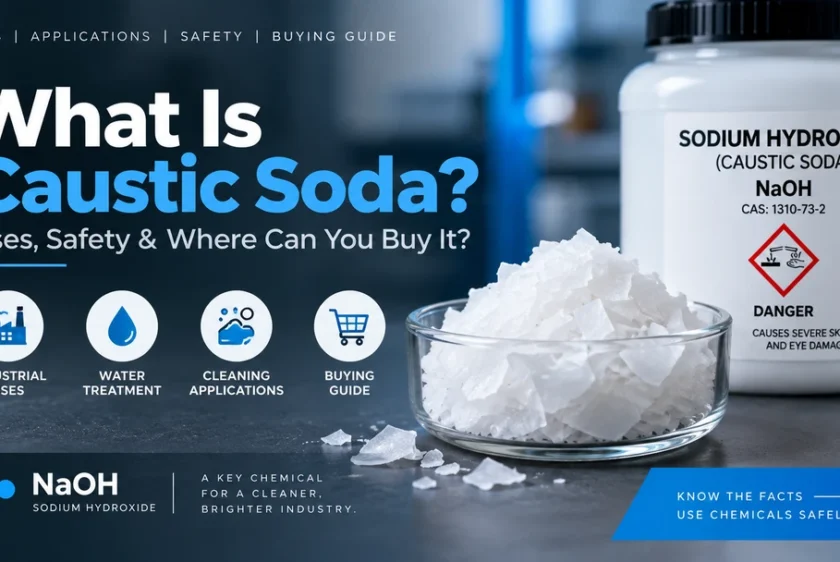
Caustic soda is sodium hydroxide, an inorganic compound with the chemical formula NaOH.
It is a strong base and is highly corrosive. Because it reacts readily with acids and can generate substantial heat when dissolved in water, it requires appropriate professional handling and storage.
Caustic soda is one of the most widely used industrial alkaline chemicals.
Caustic Soda Chemical Information
| Property | Information |
|---|---|
| Chemical name | Sodium Hydroxide |
| Common name | Caustic Soda |
| Other name | Lye |
| Chemical formula | NaOH |
| CAS number | 1310-73-2 |
| EC number | 215-185-5 |
| Molecular weight | 39.997 g/mol |
| Physical form | White crystalline solid or solution |
| Chemical type | Strong inorganic base |
| Main characteristic | Highly alkaline and corrosive |
These identifiers are listed by PubChem and the European Chemicals Agency.
What Does Caustic Soda Look Like?
Solid caustic soda is normally a white crystalline or solid material.
It readily absorbs moisture from the air, so it needs appropriate packaging and storage.
Caustic soda can also be supplied as a clear or colorless aqueous solution. The physical appearance therefore depends on whether the product is supplied as a solid or solution.
What Is Caustic Soda Used For?
Caustic soda has many industrial and commercial uses.
Some major applications include:
- Chemical manufacturing
- Pulp and paper production
- Soap and detergent manufacturing
- Petroleum processing
- Water treatment
- Wastewater treatment
- Metal processing
- Textile processing
- Cleaning products
- Laboratory applications
- pH adjustment
- Chemical processing
- Food-processing applications under appropriate regulated conditions
PubChem identifies applications including soap, rayon, paper, petroleum products, cotton processing, metal cleaning, electroplating, and chemical manufacturing.
Caustic Soda in Chemical Manufacturing
One of the largest applications for sodium hydroxide is chemical manufacturing.
Because NaOH is a strong base, it can participate in many industrial chemical processes.
It is used in the production and processing of various chemicals, including sodium salts and other industrial products.
Its ability to neutralize acids and provide a strongly alkaline environment makes it valuable across many manufacturing processes.
Caustic Soda for Soap and Detergent Manufacturing
Caustic soda has an important role in soap manufacturing.
Sodium hydroxide can react with fats and oils in a process known as saponification, producing soap.
It is also used in the broader detergent and cleaning-products industry.
This is one reason sodium hydroxide has been an important industrial chemical for many decades.
Caustic Soda for Pulp and Paper
The pulp and paper industry is another major user of sodium hydroxide.
Caustic soda is used in processing wood and other plant-based materials during pulp production.
Its alkaline properties help separate and process components of raw materials used in paper manufacturing.
This makes sodium hydroxide an important chemical in large-scale paper production.
Caustic Soda in Petroleum Processing
Sodium hydroxide is also used in the petroleum industry.
Its applications can include chemical processing and treatment processes associated with petroleum products.
PubChem and ATSDR sources identify petroleum refining and petroleum-product processing among established uses of sodium hydroxide.
Caustic Soda for Water Treatment
Caustic soda is widely used in professional water-treatment applications.
It can be used to:
- Adjust pH
- Neutralize acidic water
- Support chemical treatment processes
- Control alkalinity
- Assist certain water-processing operations
The exact amount and method depend on the characteristics of the water and the design of the treatment system.
Water-treatment facilities should use appropriate technical procedures and chemical-safety controls.
Caustic Soda in Wastewater Treatment
Wastewater-treatment facilities may use sodium hydroxide where an alkaline chemical is needed.
It can help adjust pH and support treatment processes involving acidic wastewater.
The actual treatment process depends on the composition of the wastewater and the treatment objectives.
Professional wastewater facilities should determine the appropriate chemical treatment conditions through qualified technical procedures.
Caustic Soda for Metal Processing
Sodium hydroxide is also used in metal cleaning and processing.
Its strong alkaline properties can make it useful in industrial processes involving surface treatment, cleaning, and related metal-processing operations.
Because concentrated sodium hydroxide is highly corrosive, these applications require appropriate equipment and workplace controls.
Caustic Soda in Textile Processing
Sodium hydroxide can be used in textile processing, including the treatment of cotton fabrics.
Its alkaline properties are useful in certain textile-processing stages.
The textile industry therefore represents another important professional application for caustic soda.
Caustic Soda as a pH Adjuster
One of the important properties of sodium hydroxide is its ability to increase alkalinity.
For this reason, caustic soda can be used to adjust pH in:
- Water treatment
- Wastewater treatment
- Chemical processing
- Industrial manufacturing
- Laboratory processes
The required amount depends on the starting material and the desired final conditions.
Caustic Soda Solid vs Liquid
Caustic soda can be supplied in different physical forms.
Solid Caustic Soda
Solid sodium hydroxide may be supplied as:
- Pellets
- Flakes
- Beads
- Other solid forms
The exact physical form depends on the manufacturer and product specification.
Liquid Caustic Soda
Liquid caustic soda is an aqueous sodium hydroxide solution.
Its concentration can vary significantly between products.
Therefore, buyers should never assume that all liquid caustic soda has the same concentration.
The product label, SDS, COA, and technical specification should be checked before use.
What Is Caustic Soda Made Of?
Caustic soda is sodium hydroxide (NaOH).
Its chemical formula contains:
- Sodium (Na)
- Oxygen (O)
- Hydrogen (H)
The molecular weight of sodium hydroxide is approximately 39.997 g/mol.
Caustic Soda vs Lye
Caustic soda and lye generally refer to sodium hydroxide.
The word “lye” can sometimes be used more broadly depending on the context, but sodium hydroxide is commonly called lye.
Another important distinction is between sodium hydroxide and potassium hydroxide (KOH).
Both are strong alkaline hydroxides, but they are different chemicals.
| Chemical | Formula | Common Name |
|---|---|---|
| Sodium hydroxide | NaOH | Caustic soda |
| Potassium hydroxide | KOH | Caustic potash |
They should not be treated as interchangeable products.
Is Caustic Soda Dangerous?
Yes. Caustic soda is a highly corrosive chemical.
Concentrated sodium hydroxide can cause severe burns to skin and eyes. Sodium hydroxide solutions can also damage tissue and corrode certain metals.
For this reason, professional users should always follow the applicable SDS and workplace chemical-safety requirements.
Caustic Soda Safety
Important safety principles include:
- Avoid direct skin and eye contact.
- Use appropriate protective equipment.
- Handle the material in an appropriate work area.
- Keep the chemical properly contained.
- Follow the current SDS.
- Use suitable storage containers.
- Keep it away from incompatible materials.
- Ensure personnel are appropriately trained.
Sodium hydroxide can generate significant heat when dissolved in water, so professional handling procedures should be followed.
Caustic Soda and Water
Caustic soda interacts strongly with water.
Dissolving sodium hydroxide in water releases substantial heat. This means professional users should follow the supplier’s SDS and established chemical-handling procedures rather than improvising mixing methods.
Caustic Soda and Acids
Sodium hydroxide reacts strongly and exothermically with acids.
This is one reason it should be stored separately from incompatible chemicals and handled by appropriately trained personnel.
Detailed chemical-mixing procedures should always be based on the relevant SDS and professional operating procedures.
How Should Caustic Soda Be Stored?
Caustic soda should be stored according to the manufacturer’s current SDS and applicable chemical-storage regulations.
Important considerations include:
- Keep containers properly closed.
- Protect the material from moisture.
- Use compatible containers and equipment.
- Keep away from incompatible chemicals.
- Store in an appropriate secure chemical-storage area.
- Follow applicable workplace requirements.
Sodium hydroxide absorbs moisture from air, which makes appropriate packaging particularly important.
Where Can You Buy Caustic Soda?
If you are searching where can you buy caustic soda, several types of professional suppliers may offer sodium hydroxide.
Industrial Chemical Suppliers
Industrial chemical suppliers commonly provide sodium hydroxide for manufacturing, water treatment, cleaning, and other professional applications.
Laboratory Chemical Suppliers
Laboratory suppliers may offer sodium hydroxide in smaller packages and specific laboratory grades.
Water-Treatment Chemical Suppliers
Water-treatment companies may supply sodium hydroxide for professional treatment facilities.
Chemical Distributors
Large chemical distributors can supply sodium hydroxide in different forms and quantities depending on regional availability.
When purchasing online, the most important point is to verify the exact product specification rather than buying based only on the phrase “caustic soda.”
What Should You Check When Buying Caustic Soda?
Before purchasing sodium hydroxide, professional buyers should check several important details.
1. Chemical Identity
Confirm that the product is actually sodium hydroxide (NaOH).
The CAS number is 1310-73-2.
2. Physical Form
Determine whether you need:
- Flakes
- Pellets
- Beads
- Solid material
- Liquid solution
3. Concentration
For liquid caustic soda, check the concentration carefully.
Different products can have different sodium hydroxide concentrations.
4. Grade
Depending on your application, you may need a particular grade or specification.
Examples can include:
- Industrial grade
- Laboratory grade
- Technical grade
- Other application-specific specifications
Do not assume that one grade is suitable for every application.
5. SDS
Always obtain and review the current Safety Data Sheet.
6. COA
For professional purchasing, a Certificate of Analysis can provide batch-specific information about the material.
7. Packaging
Confirm that the packaging is suitable for sodium hydroxide and appropriate for the intended quantity and transportation requirements.
8. Transportation
Sodium hydroxide is regulated as a corrosive dangerous good in relevant transportation frameworks. For example, ECHA’s EU dangerous-goods information lists solid sodium hydroxide under UN 1823 and sodium hydroxide solution under UN 1824, with Class 8 corrosive classification.
Buying Caustic Soda Online
Buying caustic soda online can be convenient for businesses and professional users, but the product should be selected carefully.
A legitimate product listing should provide enough information to determine:
- What chemical is being sold
- Whether it is solid or liquid
- The concentration where applicable
- Available quantity
- Grade or specification
- SDS availability
- COA availability
- Packaging
- Delivery requirements
Avoid relying solely on generic descriptions such as “strong lye” or “industrial alkali.”
Caustic Soda for Industrial Use
Industrial customers use sodium hydroxide across many sectors.
Potential professional users include:
- Chemical manufacturers
- Water-treatment companies
- Wastewater-treatment facilities
- Pulp and paper manufacturers
- Soap manufacturers
- Detergent manufacturers
- Petroleum companies
- Textile manufacturers
- Metal-processing businesses
- Research laboratories
- Industrial cleaning companies
The appropriate product specification depends on the individual application.
Caustic Soda Chemical Specifications
| Specification | Information |
|---|---|
| Chemical name | Sodium Hydroxide |
| Common name | Caustic Soda |
| Formula | NaOH |
| CAS | 1310-73-2 |
| EC | 215-185-5 |
| Molecular weight | 39.997 g/mol |
| Physical form | Solid or aqueous solution |
| Chemical type | Strong inorganic base |
| Main hazard | Corrosive |
| Common applications | Industrial, chemical, water treatment, cleaning, manufacturing |
The chemical identity and regulatory information are supported by PubChem and ECHA.
Caustic Soda and Regulatory Requirements
Sodium hydroxide is subject to chemical safety and transportation requirements in many jurisdictions.
In the European Union, ECHA identifies sodium hydroxide under the relevant chemical and dangerous-goods frameworks. Its harmonized classification includes Skin Corr. 1A, reflecting its serious corrosive hazard.
Transportation rules can also vary depending on whether sodium hydroxide is supplied as a solid or solution and on the concentration and packaging.
Buyers should therefore check the regulations applicable to their country and intended use.
Frequently Asked Questions
What is caustic soda?
Caustic soda is the common name for sodium hydroxide (NaOH), a strong alkaline and highly corrosive chemical used extensively in industry, manufacturing, water treatment, cleaning, and chemical processing.
What is caustic soda used for?
Caustic soda is used for chemical manufacturing, soap and detergent production, pulp and paper, petroleum processing, water treatment, wastewater treatment, textile processing, metal cleaning, and other professional applications.
Where can you buy caustic soda?
You can buy caustic soda from professional industrial chemical suppliers, chemical distributors, laboratory suppliers, and water-treatment chemical suppliers. Always verify the chemical identity, concentration, grade, SDS, COA, packaging, and delivery requirements before purchasing.
What is the chemical formula of caustic soda?
The chemical formula of caustic soda is NaOH.
What is the CAS number for caustic soda?
The CAS number for sodium hydroxide, commonly called caustic soda, is 1310-73-2.
What is the molecular weight of caustic soda?
Sodium hydroxide has a molecular weight of approximately 39.997 g/mol.
Is caustic soda the same as sodium hydroxide?
Yes. Caustic soda is a common name for sodium hydroxide (NaOH).
Is caustic soda the same as lye?
Sodium hydroxide is commonly called lye. However, buyers should check the exact chemical identity on a product label and SDS.
Is caustic soda dangerous?
Yes. Sodium hydroxide is highly corrosive and can cause severe skin burns and eye damage. Appropriate professional handling and protective measures are required.
Is caustic soda used in water treatment?
Yes. Sodium hydroxide is used in professional water and wastewater treatment, including applications involving pH adjustment and neutralization.
What is the difference between caustic soda flakes and liquid caustic soda?
Both contain sodium hydroxide, but flakes are a solid form while liquid caustic soda is an aqueous solution. Liquid products can have different concentrations, so buyers should check the product specification carefully.
Can caustic soda be used for industrial applications?
Yes. Sodium hydroxide has many industrial applications, including chemical manufacturing, pulp and paper, petroleum processing, textiles, metal processing, soap production, and water treatment.
What should I check before buying caustic soda?
Check the chemical identity, CAS number, physical form, concentration, grade, quantity, SDS, COA, packaging, transportation requirements, and applicable regulations.
Conclusion
Caustic soda is sodium hydroxide (NaOH), a strong alkaline chemical used throughout modern industry. From water treatment and chemical manufacturing to pulp and paper, soap production, petroleum processing, textile treatment, metal processing, and professional cleaning, sodium hydroxide has a wide range of established applications.
If you are searching where can you buy caustic soda, professional chemical suppliers, industrial distributors, laboratory suppliers, and water-treatment suppliers are common sources. Before purchasing, verify the exact form, concentration, grade, quantity, SDS, COA, packaging, and transportation requirements.
Because sodium hydroxide is highly corrosive, it should always be purchased, stored, transported, and handled according to the applicable safety requirements.


1 Comment
[…] For professional purchasing, buyers should also check the product specification, grade, packaging, available quantity, SDS, COA, and delivery requirements. […]